

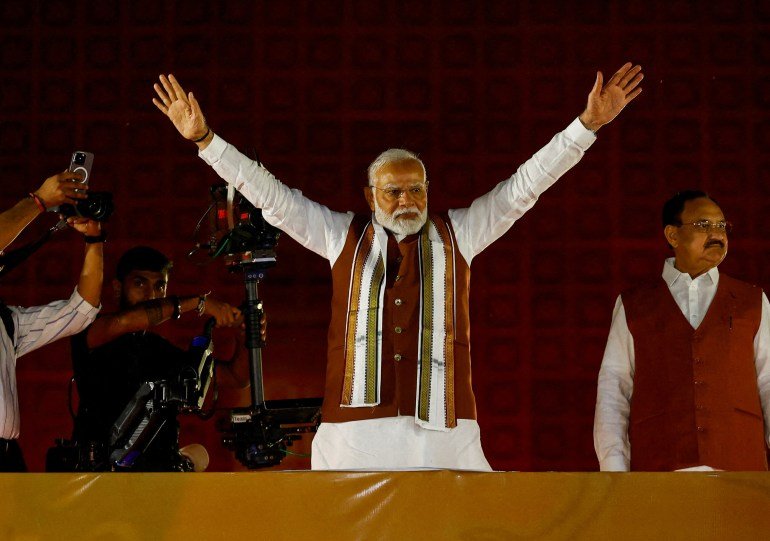
New Delhi, India — Prime Minister Narendra Modi’s Bharatiya Janata Party (BJP) has achieved a significant political milestone by securing a record third term in Haryana and demonstrating an impressive performance in Indian-administered Kashmir just four months after experiencing its first parliamentary majority loss in a decade. The assembly election results, announced this past Tuesday, have reflected a surprising resilience from the BJP, reinstating its political stronghold in these northern regions and presenting a considerable challenge to the opposition Congress party’s aspirations to regain prominence in Indian politics.
The Congress, which spearheads the Indian National Developmental Inclusive Alliance (INDIA), had previously celebrated victories in the parliamentary elections, winning 234 seats against the BJP’s 240 in June. This led to the BJP relying on coalition partners to form a government—a shift that sparked hopes of a revival for the Congress. However, the results from the Haryana assembly elections denote a stark setback for the opposition, which had initially anticipated a favorable outcome amid considerable discontent with the BJP’s state administration, particularly among farmers and prominent athletes alike.
In Haryana, despite exit polls predicting a Congress victory, the party recorded a disappointing performance, further entrenching the BJP’s dominance. Political analysts suggest that internal divisions within the Congress, as well as strategic missteps, contributed to this outcome. A political researcher attributed the Congress’s inability to present a unified front to the tensions between central and state leadership, as well as competition among party factions.
Haryana’s electoral results, wherein the BJP increased its seat count from 40 to 48, signal a consolidation of its voter base, showcasing an increase in their overall vote share. In contrast, while the Congress saw its tally rise from 31 to 36, it appears the gains came at the expense of regional parties rather than from the BJP, emphasizing the need for the Congress to address internal discord to maintain its political viability.
Furthermore, the Kashmir elections marked a new chapter in governance post-Article 370’s revocation, with the National Conference (NC) emerging as the largest party. While the Congress party did secure six seats, its influence remains limited in a changing political landscape where the NC outperformed expectations. The results signal not only a shifting dynamic in Jammu and Kashmir but also a growing appetite for regionally focused governance, strengthening local parties at the expense of national narratives.
Political commentators have noted that these developments present a unique challenge for Congress leaders, particularly Rahul Gandhi, as they navigate a complex and evolving electoral landscape. The results compel the Congress to recalibrate its strategies ahead of several critical state elections in Delhi, Maharashtra, Bihar, and Jharkhand set for the upcoming months.
In summary, the assembly elections in Haryana and Jammu-Kashmir have underscored the nuanced and vibrant nature of Indian electoral politics, reinforcing the BJP’s electoral strategy while prompting the Congress to confront significant internal challenges and recalibrate its future approach in the face of an increasingly competitive political environment.
#Politics #WorldNews