
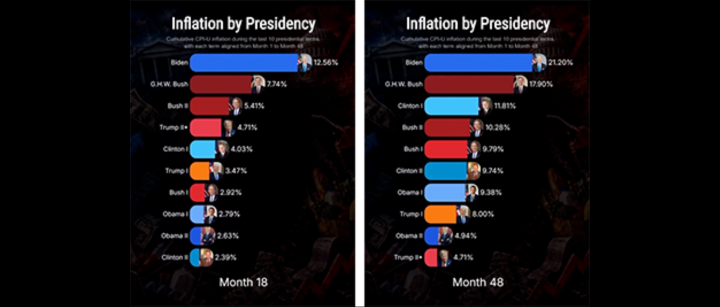

In a recent analysis, former President Donald Trump has made claims suggesting that his administration presided over the lowest inflation rate among the last ten presidents, a statement that draws scrutiny from various economic experts. This assertion is based on a chart shared on social media platforms that appears to inaccurately compare inflation during the initial period of his second term with the total inflation figures at the end of his predecessors’ full four-year terms.
To support his assertion, Trump relied on a visual infographic that displayed cumulative inflation over the first 48 months of various presidencies. While the chart titled “Inflation by Presidency” was shared on his Truth Social account, it intentionally misrepresents data by only looking at the first 18 months of his second term as a standalone figure. This misalignment becomes evident as it neglects to account for the ongoing inflation developments in the remaining months of his presidency, leading to potentially misleading interpretations.
A more thorough examination shows that, when evaluated on equal terms, Trump’s inflation figures rank him as the fourth highest among the past ten presidents after 18 months. At this juncture in his presidency, cumulative inflation stood at 4.34% from January 2025 to July 2026. Historical data from the Bureau of Labor Statistics indicates that only three recent administrations experienced greater inflation in their first 18 months in office, highlighting the challenges faced by his administration.
In light of this, officials from Trump’s administration assert that he inherited a significant inflation crisis and have taken pride in policy efforts aimed at stabilizing prices in key sectors, including essential goods and services. These claims, while verified to some extent in regards to specific price drops, must be contextualized within the broader landscape of overall inflation rates.
Critics argue that Trump’s interpretations and representations of inflation data tend to lack clarity and accuracy, prompting concerns about the potential implications this has on public understanding of economic performance. The complexity of economic metrics and their implications for everyday life emphasizes the importance of informed discussions regarding fiscal policies.
As the broader economic narrative continues to unfold, the role of accurate data representation in public discourse remains a critical component of understanding leadership in times of economic uncertainty. As citizens navigate the evolving landscape of the economy, it is vital they engage with information that reflects the nuanced realities behind these figures.
#PoliticsNews #WorldNews