
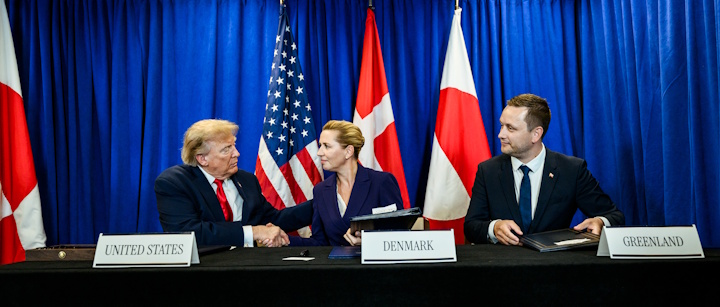

Under a newly established defense agreement involving Greenland, Denmark, and the United States, Greenland retains its status as a self-governed territory of Denmark while preserving the option for future independence. Contrary to recent claims by President Trump, the U.S. does not have complete ownership of Greenland, nor is it an acquisition as he had suggested during his speeches.
At the World Economic Forum in Davos earlier this year, President Trump expressed a desire for the U.S. to take ownership of Greenland, an Arctic island with a population of approximately 57,000. He argued that formal ownership is necessary for effective defense strategies. However, the new trilateral agreement does not transfer ownership; rather, it facilitates an expanded American military presence and deters adversaries from establishing a foothold in the region.
On November 3, members of the Greenlandic parliament approved the agreement, which awaits final confirmation by Danish lawmakers later this month. The framework under the new agreement allows the U.S. to enhance military operations at the Pituffik Space Base, primarily focusing on space surveillance and missile defense capabilities.
Despite President Trump’s enthusiastic proclamations of “acquiring” Greenland, experts in international relations caution that the treaty does not significantly alter the existing military access that the U.S. already enjoys under previous agreements. Many analysts, including Otto Svendsen from the Center for Strategic and International Studies, describe the developments as marginal improvements that reinforce existing frameworks rather than groundbreaking advances.
The agreement, which was first signed on September 22, updates a defense pact established in 1951. While enabling enhanced capabilities at U.S. bases in Greenland, it simultaneously underscores Greenland’s rights to self-determination, maintaining its place within Denmark. Importantly, should Greenland choose to pursue independence, the treaty would continue to bind it to NATO agreements, ensuring that the U.S. remains involved in its defense.
The renewed emphasis on Greenland illustrates the strategic importance of the Arctic region, especially in light of rising geopolitical competition with powers such as Russia and China. The agreement epitomizes the delicate balance between enhancing military capabilities and respecting the autonomy of Greenlandic governance.
In conclusion, while President Trump’s characterization of the agreement may suggest a dramatic shift in geopolitical control, the realities of the situation reflect a commitment to ongoing collaboration, security, and respect for Greenland’s autonomy under Danish jurisdiction.
#MiddleEastNews #PoliticsNews