
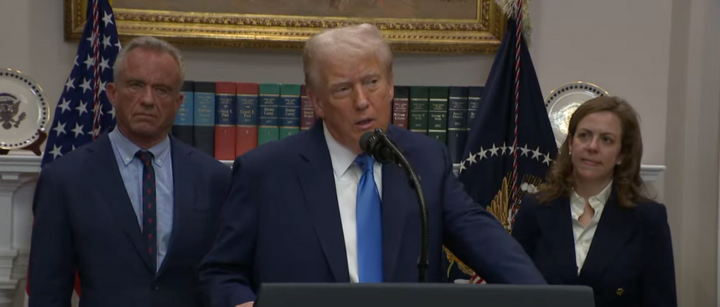

In a recent press conference addressing autism, President Donald Trump, alongside Health and Human Services Secretary Robert F. Kennedy Jr., made numerous claims regarding autism and vaccines that have sparked significant scrutiny from health experts. The event, held on September 22, 2025, was characterized by what critics have described as a series of misleading statements and falsehoods regarding the relationship between autism and vaccines.
Dr. Paul Offit, a pediatrician and vaccine expert at the Children’s Hospital of Philadelphia, described the presentation as “a fire hose of misstatements,” highlighting a troubling trend wherein such inaccuracies can create confusion among parents and adversely impact individuals living with autism. The American Academy of Pediatrics subsequently issued a statement expressing concern that the claims made during the conference could send “a confusing message to parents and expecting parents.”
Among the contentious points raised during the conference, Trump exaggerated historical autism prevalence rates, asserting dramatic increases that researchers attribute to greater awareness and broader diagnostic criteria over the years. This claim was met with pushback, as experts suggest that the rise in reported autism cases has more to do with societal changes in how autism is diagnosed and recognized rather than an actual increase in incidence.
Kennedy similarly drew criticism when he dismissed the significance of changing diagnostic methods, calling it a “canard.” His assertion that “full-blown autism” exists exclusively in individuals under the age of 50 was also challenged as misleading, as the spectrum of autism uniquely encompasses individuals of all ages.
The duo’s claims surrounding vaccines drew particular ire, as substantial research contradicts the notion of a causal link between vaccines and autism. In fact, a considerable body of evidence supports the safety and efficacy of vaccines, including the Measles, Mumps, and Rubella (MMR) vaccine. They have been proven safe through extensive, rigorous studies conducted across numerous populations. Despite this, the narrative presented at the press conference may contribute to ongoing vaccine hesitancy—an issue that public health advocates work tirelessly to combat.
Trump also made inaccurate claims regarding the Amish community, suggesting they do not experience autism due to low vaccination rates. Experts argue that while some Amish groups may choose to forgo vaccines, no definitive data shows that autism rates are nonexistent within this population. Studies indicate that autism is present among Amish children, albeit at potentially lower rates than in the general population, likely influenced by factors such as healthcare access and recognition.
In discussions about the hepatitis B vaccine, Trump suggested delaying its administration until children are older, despite expert opinions emphasizing the importance of early vaccination in preventing lifelong health risks.
Health professionals continue to advocate for transparency and accuracy in discussions about autism and vaccines, emphasizing that misinformation can have real-world repercussions for public health. As this debate unfolds, maintaining the integrity of health communications remains crucial in safeguarding the well-being of individuals across all communities.
#HealthNews #PoliticsNews