
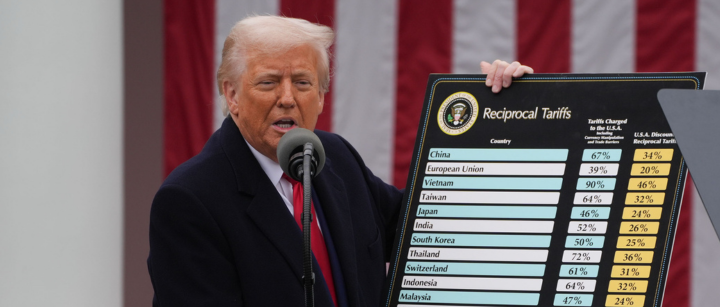

In a recent announcement delivered from the Rose Garden, President Donald Trump introduced a sweeping proposal for new “reciprocal tariffs” aimed at addressing perceived trade imbalances with various nations. This approach was bolstered by a chart the President presented, which claimed to illustrate tariffs imposed by other countries on U.S. goods and the new rates the U.S. would place on imports from those nations.
Trump described these tariffs as straightforward, stating, “Reciprocal. That means they do it to us and we do it to them.” He announced a minimum baseline tariff of 10% on all imported goods and indicated that the U.S. might impose tariffs equal to half of what foreign countries charge for U.S. goods, projecting that this could lead to a substantial increase in tariffs—potentially as high as 50% for certain imports.
However, scrutiny of the data revealed discrepancies. Critics pointed out that the tariffs Trump referenced were misrepresented, citing much higher rates than those reported by the World Trade Organization (WTO). This chart included vague references to “currency manipulation and trade barriers,” complicating the assessment of actual tariff levels. Experts noted that this approach is problematic because it oversimplifies the complex dynamics of international trade.
The Office of the U.S. Trade Representative (USTR) clarified that the reciprocal tariffs were intended as a measure to balance bilateral trade deficits. While they acknowledged the complexity of calculating such tariffs, their methodology, which involved dividing the size of trade imbalances by U.S. imports from each country, faced significant criticism from economists. Many assert that relating tariff rates directly to trade deficits does not accurately reflect real barriers to trade.
For instance, President Trump suggested that the European Union (EU) imposes tariffs averaging 39% on U.S. imports, leading to his proposed reciprocal rate of 20%. This assertion has been met with skepticism, as the true trade-weighted average tariff rate for the EU is recognized to be much lower, at around 2.7%. Moreover, economists highlighted that evaluating tariffs without considering service trade, where the U.S. maintains a surplus, could skew results and lead to an incomplete analysis of trade relationships.
The implications of these proposed tariffs raise concerns, as many argue that they do not effectively target the factors that contribute to trade deficits, which can include demand dynamics and consumer preferences, rather than solely tariff rates. Tariffs can disrupt the flow of trade, potentially leading to retaliatory measures from affected countries, which would further complicate the landscape of international trade.
In summary, while the call for reciprocal tariffs is framed as an effort to redress trade imbalances and protect American interests, the underlying methodology and projected outcomes have drawn considerable scrutiny from economists and trade experts. The debate surrounding these tariffs underscores the intricate interplay of global trade dynamics, and the need for a nuanced approach to address international economic relationships effectively.
#PoliticsNews #WorldNews