

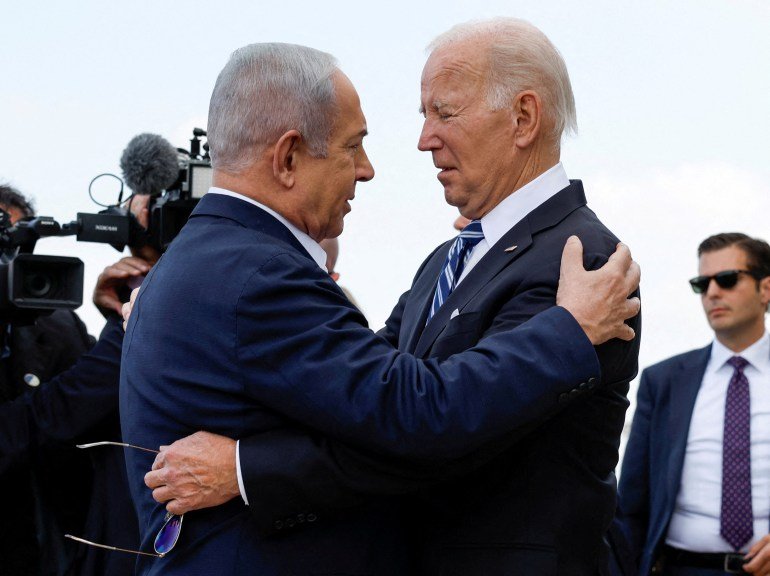
US Support for Israel Amid Ongoing Gaza Conflict Raises Questions
Washington, DC – In February, President Joe Biden expressed optimism that a ceasefire in Gaza was “so close” it could be realized within days while delighting in a simple moment with an ice cream cone. However, more than seven months later, the violence in Gaza, as well as across the broader Middle East, has intensified rather than diminished.
Israel’s military operations in Gaza have continued unabated, resulting in the tragic loss of nearly 42,000 lives, while the conflict has also spilled into Lebanon. The Biden administration has maintained a dual approach, publicly calling for de-escalation and negotiations while simultaneously extending significant political and military support to Israel. This includes supplying munitions that sustain Israel’s military operations.
As the situation has escalated, the US government’s stance on Israeli actions has often aligned closely with those of Israel. From targeting leaders of Hamas in Beirut and Tehran to endorsing military actions against Hezbollah, the United States has demonstrated a pattern of backing Israel’s initiatives, even as tensions rise.
The humanitarian crisis in Gaza continues to deepen, with many critics suggesting that the Biden administration’s support for Israel may contribute to the ongoing violence. Despite calls for restraint, analysts argue that the US, rather than acting as a neutral facilitator, is complicit in the regional tensions due to its unwavering support for the Israeli government’s aggressive policies.
The recent conduct of the Biden administration indicates a pivot in focus after months of advocating for ceasefire discussions, as it now appears to endorse military action in Lebanon. Comments made by US Secretary of Defense Lloyd Austin reiterate this stance, emphasizing Israel’s right to defend itself.
Public sentiment on the Biden administration’s handling of the Israeli-Palestinian conflict has been shifting, leading scholars and analysts to question the efficacy of US diplomatic efforts. Osamah Khalil, a history professor at Syracuse University, has pointed out that US initiatives aimed at finding diplomatic solutions appear insincere, designed rather to mitigate domestic criticism than to produce genuine results.
Furthermore, recent media reports suggest US officials privately support Israeli military actions against Hezbollah, framing it as a pivotal moment that could reshape the political landscape of the Middle East for the better—a sentiment reminiscent of earlier, more contentious US foreign policy strategies.
As the Biden administration struggles to reconcile its diplomatic overtures with the stark realities on the ground, prominent voices in the academic and political arenas urge for a more balanced approach that recognizes and supports the rights and aspirations of all communities in the region. The complexities of the ongoing conflicts underscore the need for a more robust and equitable foreign policy that prioritizes peace and stability.
While the resolution seems elusive, calls for a just solution continue, advocating for understanding, dialogue, and ultimately, a path toward lasting peace.
#Politics #WorldNews