
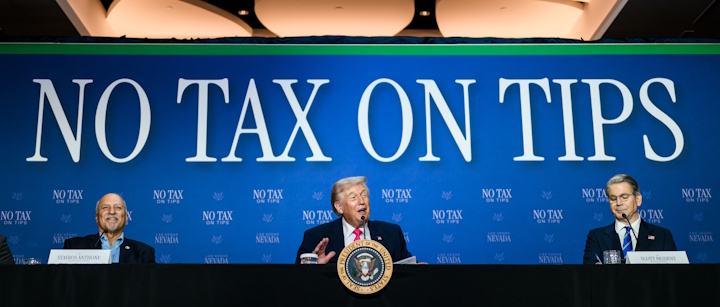

In recent discussions regarding economic policy, President Donald Trump’s assertions about the “no tax on tips” initiative have elicited scrutiny as details surrounding its impact on tipped workers in states like Nevada and Georgia surface. The President claimed that this policy has enabled around 440,000 tipped workers in Nevada to save an average of ,000 on their taxes, while 130,000 workers in Georgia purportedly saved over ,000. However, the White House has yet to provide substantial federal data to substantiate these figures.
Critics suggest that the savings mentioned may be based on average amounts that workers in these and similar positions could potentially deduct from their taxable income as opposed to actual taxes saved. The deductions are capped annually and vary significantly depending on individual tax rates. Many experts have pointed out that these deductions do not represent actual tax savings dollar-for-dollar and are, instead, reductions on the amount of income subject to taxation.
Trump’s remarks were made during an economic speech at the Red Rock Casino Resort and Spa in Las Vegas. He emphasized that the administration’s efforts had led to substantial financial benefits for working-class Americans, particularly in Nevada, where he claimed that his tax policies were a boon to tipped employees.
The “One Big Beautiful Bill Act,” which Trump signed into law, established a temporary federal tax deduction for qualified tips, starting in the 2025 tax year and lasting until 2028. Though the legislation has been promoted as a means to uplift workers, it is clear that the actual benefit may only extend to a small fraction of eligible workers.
The Tax Policy Center estimates that around 3% of U.S. households would realize any benefits from the deduction, with an average savings projected at approximately ,400 per household. Furthermore, it is crucial to note that many individuals involved in tipped occupations may not generate enough income to benefit from the deduction at all, particularly if they are already utilizing the standard deduction, which significantly limits their tax liability.
While the potential for savings exists, the actualization of these benefits remains in question. As Trump’s claims about the number of eligible recipients in states like Nevada and Georgia continue to be analyzed, the gap between promise and reality highlights the complexities involved in tax policy and its implications for the workforce.
The conversation surrounding tax policy and working Americans captures the attention of policymakers, advocacy groups, and workers alike as they navigate the financial landscape shaped by recent legislation. ZezapTV will continue to monitor these developments and provide updates as further information becomes available.
#PoliticsNews #BusinessNews