
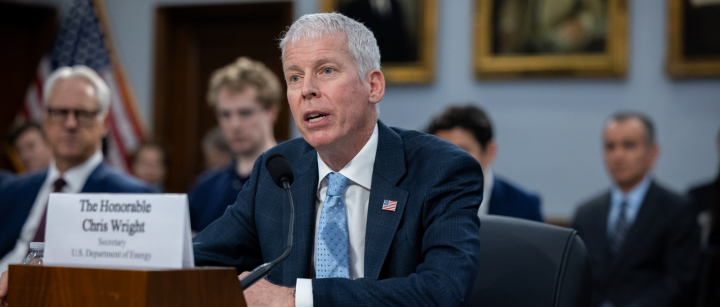

Energy Secretary Chris Wright has consistently refuted claims that political motivations influenced the cancellation of over 280 energy grants last October. Recent court documents, however, indicate that Department of Energy (DOE) attorneys acknowledged that the recipients of the terminated grants were located predominantly in states that leaned Democratic in their voting patterns, raising questions about the decisions made.
Wright and the DOE assert that political factors played no role in the initial evaluation of the grants slated for termination, which encompassed projects from both Democratic and Republican regions focused on clean energy and energy efficiency. However, the list of ultimately canceled grants revealed a significant trend: nearly all were in states that had voted for Democratic nominee Kamala Harris in the 2024 presidential election.
A comprehensive review of approximately 2,300 grants led to the designation of 624 for possible termination, which was subsequently communicated to the Office of Management and Budget (OMB) in September. Of the 284 grants that received termination notices in October, all but one were located in Democratic states, while the 340 projects remaining in Republican states were excluded from this action. This stark contrast has prompted scrutiny and speculation, as the DOE admitted in court filings that the states’ political affiliations were the only basis for these decisions.
In an interview with CNN, Secretary Wright described the decisions leading to grant terminations as being based solely on factual evaluations, despite the growing suspicion that political affiliations played a substantial role. His insistence that the project evaluations had no political considerations diverges from the court document’s admission regarding the rationale for canceling the grants. Even as he denied any political motive, he acknowledged ongoing evaluations might eventually yield more terminations across the political spectrum.
The situation has escalated to political scrutiny, with Democratic representatives referring Wright to the Department of Justice for potentially misleading Congress in his testimony. Experts suggest that while a formal prosecution may be unlikely, the case highlights a complicated intersection of policy, politics, and the implications for the energy sector and grant recipients.
The initial announcement of these grant cancellations indicated that the projects in question were deemed not to contribute significantly to the nation’s energy goals or to offer a reasonable return on taxpayer investment. However, the context surrounding these decisions has renewed discussions about political influence in governmental operations, particularly regarding the energy sector.
The implications of these cancellations can impact future investments in clean energy initiatives, especially in regions that may feel disenfranchised by such politically charged decisions. The DOE’s ongoing efforts to clarify its process and decisions may serve to restore confidence among stakeholders in the pursuit of an equitable energy transition.
#PoliticsNews #EnergyNews