
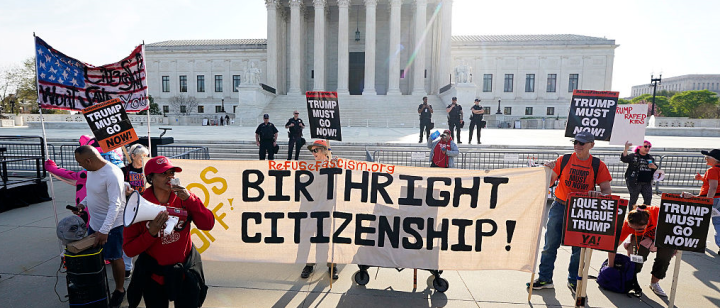

In a significant ruling, the Supreme Court recently upheld birthright citizenship as dictated by the 14th Amendment, a decision that has sparked calls from former President Donald Trump and others to pursue legislative means to alter this provision. Following the court’s ruling, Trump expressed his dissatisfaction through social media, advocating for Congressional action rather than a lengthy constitutional amendment process. However, legal experts highlight that the court’s opinion emphasizes that a constitutional amendment is the requisite mechanism for any changes regarding citizenship rights.
The 14th Amendment, ratified in 1868, asserts that “All persons born or naturalized in the United States, and subject to the jurisdiction thereof, are citizens of the United States and the State wherein they reside.” This constitutional clarity suggests limited pathways for Congress to redefine birthright citizenship without a formal legislative overhaul.
As the legal landscape stands, efforts to rescind birthright citizenship through standard legislation appear unlikely to succeed in the courts, even as some Republican voices advocate for such changes. Constitutional scholars agree that any legislation attempting to redefine this longstanding right would face formidable challenges within the judicial system. Chief Justice John Roberts, in articulating the court’s decision, reinforced the constitutional assurance of citizenship for individuals born in the U.S., including those with parents who may not be in the country lawfully.
Despite dissenting opinions within the court, notably from Justice Brett Kavanaugh, there remains a lopsided consensus that the right to citizenship at birth is a constitutional guarantee. Scholars have pointed out that any legislative attempts to undermine this principle would not align with the court’s interpretation, reflecting a commitment to uphold civil rights as foundational to American democracy.
The dialogue surrounding birthright citizenship also highlights the broader themes of citizenship, identity, and community participation. Advocates, including legal experts from various institutions, assert that the decision not only affirms existing rights but also embodies the values of inclusivity that can enhance the nation’s societal fabric.
As the discourse continues, it is evident that any attempts to modify the birthright citizenship framework will require robust legislative action or constitutional amendments, ensuring that the foundational principles of citizenship remain intact. The ruling signifies a clear delineation of rights that aligns with democratic ideals, providing a pathway for further discussions on immigration and citizenship in a diverse society.
#PoliticsNews #MiddleEastNews