
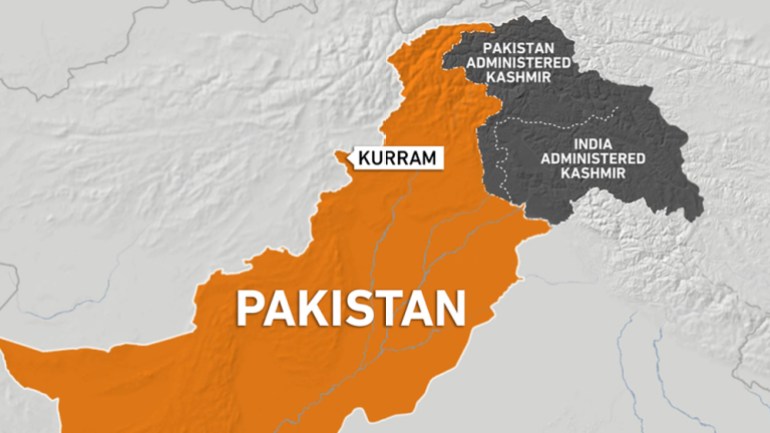

Islamabad, Pakistan – The main highway connecting Pakistan’s Kurram district has remained closed for over four weeks due to ongoing sectarian tensions, rooted in land disputes, in this scenic area bordered by Afghanistan. This picturesque mountainous region in Khyber Pakhtunkhwa province has faced persistent strife since late July, when a disagreement between Shia and Sunni tribes culminated in a tragic loss of at least 46 lives.
In response to the violence that erupted in July, authorities instituted travel restrictions and heightened security measures to protect the residents. Unfortunately, these efforts have not entirely mitigated further retaliatory attacks among tribal factions. A particularly violent incident on October 12 saw a convoy ambushed, resulting in the deaths of at least 15 individuals.
Local peace committee member Mehmood Ali Jan shared that, for the past several months, travel has only been permitted in convoys. However, following the recent fatalities, authorities have further restricted travel to the general public. Last week, thousands convened for a “peace march” in Parachinar, the district headquarters, calling on the government to bolster security for Kurram’s population of approximately 800,000, over 45 percent of whom belong to the Shia minority.
In the wake of the march, authorities have allowed convoy travel four days a week, a sign of cautious optimism, as indicated by Kurram’s deputy commissioner Javedullah Mehsud. He noted a cooperative approach between Shia and Sunni groups is hoped to be maintained in the interests of public safety while concurrently addressing security concerns.
Kurram’s history of sectarian discord has been marked by significant violence, primarily between Shia and Sunni factions. Between 2007 and 2011, over 2,000 lives were lost due to conflicts in the region. Furthermore, its geographical proximity to Afghanistan’s Khost, Paktia, and Nangarhar provinces has fostered an environment primarily exploited by armed groups, including the Pakistan Taliban (TTP) and ISIL (ISIS), which hold vehement anti-Shia ideologies.
Although an intertribal ceasefire was implemented in August following July’s upheaval, the violence reignited in late September, claiming the lives of 25 people and compounding the community’s struggles. Following the attack on October 12, a temporary ceasefire was established as local leaders and authorities worked towards a solution. Optimism remains that mutual cooperation could restore peace, although challenges persist due to lingering tensions and infrastructure disruptions such as road closures and an ongoing mobile internet blackout.
Local stakeholders emphasized the urgent need for mediation by state authorities to prevent the situation from escalating further, particularly regarding the persistent land dispute and its sectarian implications. The community remains on edge, underscoring the need for dialogue and resolution to pave the way for lasting tranquility in Kurram.
In conclusion, while the recent peace march and the government’s renewed efforts to facilitate safe travel may signal a step towards amelioration, deep-seated issues necessitate genuine commitment from all parties involved to achieve a sustainable resolution to the underlying conflicts.
#MiddleEastNews #PoliticsNews